Close Third Person or First Person: Where Should the Story Sit?
Compare close third person or first person through one character’s dilemma, and choose the viewpoint that best balances interior access, distance, and flexibility.
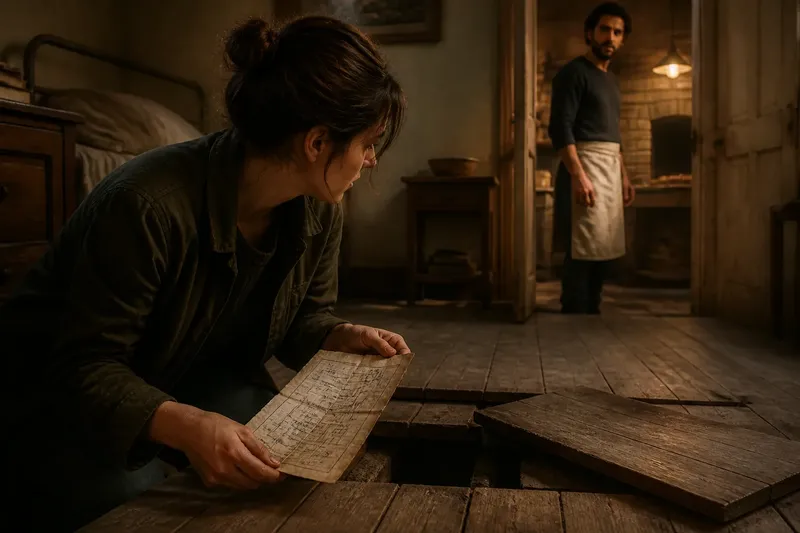
Mara finds a folded map tucked beneath the loose floorboard of her rented room. Close third person or first person will determine how a reader meets that discovery: through Mara’s immediate account, or through narration that stays close to her while calling her “she.” The difference is not simply a choice between “I” and “she.” It is a choice about what the narrative can say, how close it sounds, and how easily its voice can shift.
Imagine a hypothetical story in which Mara has one evening to decide whether to hand the map to her older brother, Leon. It appears to show a passage beneath the family’s closed bakery. Mara suspects Leon has been concealing something, but she does not know what. The scene begins with the map, moves through a tense meeting, and ends when Mara makes her choice. Following this invented situation makes the trade-offs easier to see.
What can each viewpoint tell the reader?
In first person, Mara narrates as “I.” The reader receives her thoughts and perceptions in the voice she uses to tell the story. She can say what she saw, what she guessed, and what she remembers; the narration can also reveal how she frames those things.
In close third person, the narration uses “Mara” or “she” but remains within her immediate experience. It can report her thoughts and sensations without sounding like a separate observer. A close-third sentence might read, “The map smelled of flour and damp paper. Leon had been in the bakery after all.” The second sentence is Mara’s inference, not an established fact.
That distinction matters. Neither viewpoint gives the reader direct access to Leon’s private thoughts if the story stays with Mara. First person makes that limit especially visible: Mara cannot report what Leon thinks unless he tells her or she imagines it. Close third can feel slightly more flexible, but it cannot honestly turn an unknown motive into known fact without changing the point of view or marking it as speculation.
Both forms can present the same physical detail, memory, or suspicion. Their different strength lies in the texture of access. First person makes the filter unmistakable: everything comes through a narrator who says “I.” Close third person can keep the same intimacy while letting the prose move between Mara’s immediate perception and a more neutral description.
How does the choice change emotional distance?
First person puts Mara’s voice in the foreground. She might notice that the map’s blue ink matches the mark on her thumb, then confess that she wants the mark to prove Leon has lied. Her syntax, word choice, and self-corrections can expose her personality even when she is trying to sound calm.
But first person also raises a question of telling. Is Mara describing events as they happen, or looking back later? A retrospective narrator can understand more than her earlier self did, conceal information, or interpret the evening with hindsight. If the story does not establish that frame, such knowledge can feel like an unexplained leak from the future.
Close third person can keep the reader close without requiring Mara to sound like she is narrating aloud. It can stay with her hands, attention, and assumptions while retaining a little space around her. That space helps when the prose needs to describe a room or action plainly, then return to her reaction.
Think of first person as a window with the narrator’s handwriting on the glass: the view is vivid, but the marks are part of it. Close third can show the same view without making the narration itself Mara’s spoken or written account. Neither is inherently more intimate. The sentence-level choices create intimacy; the pronouns set its conditions.
What happens when the scene reaches Leon?
In the hypothetical story, Mara meets Leon at the bakery’s back door. He sees the map in her hand and asks where she found it. His pause could mean fear, guilt, surprise, or a simple effort to choose his words. The viewpoint should let the reader feel the uncertainty instead of quietly resolving it.
In first person, Mara might narrate, “Leon looked at the map. For a moment, I thought he was afraid. Then he asked whether I had shown it to anyone.” The sequence distinguishes observation from interpretation. The reader can judge whether Mara’s guess fits his question, while remaining inside her response.
Close third can make the same distinction: “Leon looked at the map. Was that fear? Mara tightened her grip. Then he asked whether she had shown it to anyone.” The question belongs to her immediate attention. The narration need not declare that Leon is afraid merely because Mara suspects it.
At the climax, Mara chooses not to hand over the map. She slips it into her coat and tells Leon she has already copied it, although she has not. In first person, the lie can arrive beside the impulse that produces it: “I said I’d made a copy. The lie came out before I could decide whether to trust him.” In close third, the narration can likewise keep the action close: “She said she’d made a copy. The lie came out before she could decide whether to trust him.” The pronoun changes; the moral uncertainty does not.
Which form gives a story more flexibility?
For a single viewpoint character, both forms can stay consistent across a full story. Close third often offers more room to vary narrative texture. It can describe the bakery’s cracked tile in plain language, then slip into Mara’s thought: “The old place still smelled of warm sugar. The map had no business being here.” The narration can move between scene-setting and her idiom without presenting every sentence as her act of telling.
First person has a different kind of flexibility: voice can become part of the plot. Mara might minimize her own fear, repeat Leon’s phrases, or contradict her earlier account. A reader can notice those habits. This is useful when the character’s way of narrating is itself significant, not merely a convenient route into her thoughts.
Neither choice automatically permits a scene from Leon’s private perspective. If the story must show what he knows while Mara is absent, the writer needs a deliberate structural solution: another viewpoint, a later account, or information Mara receives. Switching from “I” to “she” does not solve that access problem by itself.
How can you choose between close third person and first person?
Try the same short passage in both forms before committing. Keep the events fixed: Mara finds the map, notices the flour on its fold, and considers whether to confront Leon. Then ask what each version lets the prose do.
- Choose first person if Mara’s own phrasing, evasions, or retrospective interpretation should shape the reader’s experience.
- Choose close third person if you want intimate access but need more room for neutral description and subtle shifts in narrative texture.
- Check knowledge boundaries by marking what Mara sees, remembers, infers, and cannot know. Keep guesses distinct from facts in either form.
- Read for voice by circling sentences that could only sound like Mara. If that quality matters throughout, first person may bring it forward; close third can still carry it through free indirect thought.
- Test the scene’s turning point by comparing how the lie sounds in each version. Prefer the form that makes Mara’s choice clear without explaining away its uncertainty.
These are not rules about which pronoun is more literary. They are checks on what the story asks the reader to notice. A first-person narrator can be spare and guarded; close third can be intensely subjective. The right form is the one whose limits help the scene rather than forcing repeated explanations.
Which viewpoint questions should you ask before drafting?
Can first person include thoughts the character does not want to admit?
Yes. A first-person narrator can confess, evade, joke, or contradict herself, and those choices can reveal what she resists saying directly. The reader still encounters the thought through her telling voice.
Can close third person use the character’s own words?
Yes. Close third can take on a character’s vocabulary and rhythm without switching to “I.” This technique, often called free indirect discourse, lets narration blend with thought while keeping the grammatical person in third.
Can close third person show another character’s thoughts?
Not while remaining strictly within one character’s viewpoint. It can show another person’s words, gestures, and behavior, but their private thoughts must remain unknown unless the story shifts viewpoint or the focal character learns them.
Should a narrator explain what a character felt?
Only when the explanation adds something the scene’s actions and perceptions do not already convey. A concise statement can clarify a reaction, but repeated labels such as “she was frightened” may flatten a moment that could be carried by what she notices or does.
What should the final choice make possible?
Return to Mara’s decision, not to the pronouns in isolation. If the story gains force from her telling—the small excuses, the sharp observations, the version of events she wants to believe—first person gives that voice a permanent seat at the table. If the story needs her immediate perceptions without making every passage sound like a report from her, close third may fit better.
Read the final page aloud in the chosen form. Listen for a sentence that claims more than Mara could know, a thought that sounds unlike her, or a description that becomes awkward because it is forced into a confession. Fix the sentence before reconsidering the whole viewpoint. For this particular choice, close third person or first person is best judged by what it lets the reader experience at the moment Mara keeps the map: her account of the choice, or the choice unfolding close around her.